
Civil Services Examination (CSE)
A comprehensive directory mapping syllabus details, exam structure, age limits, attempt policies, salaries, and personality test preparation guidelines.
About the UPSC Examination
The UPSC Civil Services Examination (CSE), conducted by the Union Public Service Commission, is one of India’s most prestigious and challenging competitive examinations. It serves as the gateway to recruitment for the Indian Administrative Service (IAS), Indian Police Service (IPS), Indian Foreign Service (IFS), and other premier central Group A and Group B civil services.
Preliminary Exam
Objective test acting as a screening filter. Comprises two papers of 200 marks each, held on the same day:
- • GS Paper I: Cutoff determining paper (History, Polity, Geography, Economy, CA).
- • GS Paper II (CSAT): Qualifying paper requiring a minimum score of 33%.
Mains Examination
Written descriptive examination checking core depth. Consists of 9 papers, totaling 1750 marks which determine final rank:
- • 1 Essay Paper (250 marks)
- • 4 General Studies Papers (GS I-IV, 250 marks each)
- • 2 Optional Subject Papers (250 marks each)
- • 2 Qualifying Language Papers (not counted for rank)
Personality Test
Final interview stage worth 275 marks. Board evaluates candidate's suitability for administrative responsibilities:
- • Assesses logical thinking, critical expression, and depth of interest.
- • Focuses on balance of judgment, leadership, and moral integrity.
General Studies Core Subjects
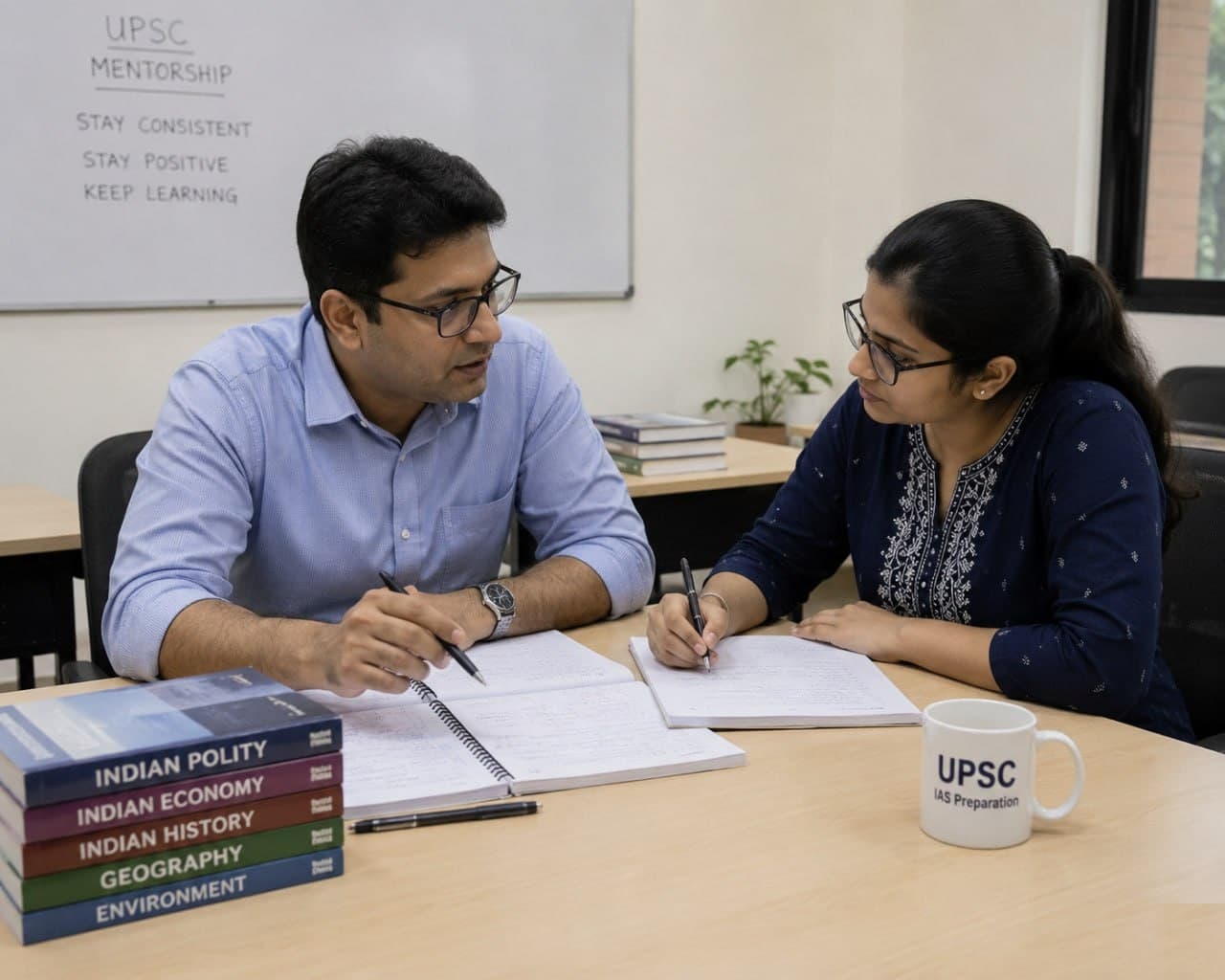
Mastering the core General Studies subjects is crucial for both Prelims and Mains. Our syllabus roadmap bridges Indian Polity, Economy, History, Geography, and Environment with current affairs to build a solid foundation.
Preparation Journey
Success in UPSC demands regular practice, consistent routines, conceptual clarity, and connecting current events with the static syllabus. At Mihya, we structure our foundation classes specifically around dynamic linkages to prepare you for any exam trend.
UPSC Eligibility Criteria
To apply for the UPSC CSE, candidates must fulfill nationality, age limits, category attempt limits, and educational parameters prescribed by the commission.
Nationality
For primary roles (IAS, IPS, IFS), candidates must be Citizens of India. For other services, citizens of Nepal, Bhutan, Tibetan refugees (pre-1962), or permanent PIO migrants are eligible with a government certificate.
Education
A bachelor’s degree from a recognized university. Final-year undergraduate students are eligible to apply for Prelims, but must prove graduation during applying for the Mains Examination. Medical students with completed MBBS awaiting internship are eligible.
Age Base
Candidates must be between 21 and 32 years of age on August 1st of the examination year. For the current cycle, candidates should have been born between August 2, 1994 and August 1, 2005 (relaxations apply category-wise).
Category-Wise Age Limit & Attempt Matrix
| Category | Minimum Age | Maximum Age | Age Relaxation | Attempts Allowed |
|---|---|---|---|---|
| General / EWS | 21 Years | 32 Years | No Relaxation | 6 Attempts |
| OBC | 21 Years | 35 Years | +3 Years | 9 Attempts |
| SC / ST | 21 Years | 37 Years | +5 Years | Unlimited |
| PwBD (Persons with Disabilities) | 21 Years | 42 Years | +10 Years | 9 (Gen/OBC) / Unlimited (SC/ST) |
| Ex-Servicemen (General) | 21 Years | 37 Years | +5 Years | 6 Attempts |
Restrictions on Re-applying:
Candidates already appointed to the IAS or IFS (Indian Foreign Service) from a previous examination cycle who are currently serving are not eligible to sit for the examination again. IPS officers cannot opt for the IPS service in their choice sheets if currently serving.
Physical & Medical Standards:
Candidates must pass a designated medical fitness test. Specific technical roles (such as IPS, RPF, or police services) enforce strict physical requirements regarding height, weight, chest expansion, and visual acuity (based on Gazette norms). Non-technical roles only require basic physical fitness and mental stability.
Official Notification & Bureaucratic Salaries
UPSC releases the official Civil Services Examination Notification annually on its official website, outlining the vacancy calendar, rules, and application windows. Alongside prestige, civil service careers offer rewarding consolidated pay scales and administrative authority.
Official Commission Portal
Check vacancy parameters, notifications, schedules, guidelines, and apply online.
Rank-Wise IAS Salary Structure (7th Pay Commission)
Starting Basic: ₹56,100 / Month| Designation / Role | Pay Matrix Level | Basic Pay (Per Month) | Service Experience |
|---|---|---|---|
| Sub-Divisional Magistrate (SDM) / Assistant Secretary | Pay Level 10 | ₹56,100 | 0–4 Years |
| Additional District Magistrate (ADM) / Undersecretary | Pay Level 11 | ₹67,700 | 4–9 Years |
| District Magistrate (DM) / Deputy Secretary | Pay Level 12 | ₹78,800 | 9–12 Years |
| District Magistrate (DM) / Director in GOI | Pay Level 13 | ₹1,18,500 | 12–16 Years |
| Divisional Commissioner / Joint Secretary in GOI | Pay Level 14 | ₹1,44,200 | 16–25 Years |
| Divisional Commissioner / Principal Secretary | Pay Level 15 | ₹2,05,400 | 25–30 Years |
| Chief Secretary / Secretary in GOI | Pay Level 17 | ₹2,25,000 | 34–36 Years |
| Cabinet Secretary of India (Apex Post) | Pay Level 18 | ₹2,50,000 | 37+ Years |
Allowances
IAS officers receive a Dearness Allowance (DA), which is subject to regular cost-of-living updates. HRA ranges from 8% to 24% of basic pay depending on the city posting. Transport allowances (TA) are provided to cover travel expenses.
Perks & Accommodation
Perks include government-provided residence/bungalow with support staff, security details, official vehicles with drivers, subsidized utilities, medical allowances for family, and study leave options.
Ranks Progression
Starting as Sub-Divisional Magistrates (SDM), officers grow to District Collectors (DM), Divisional Commissioners, Secretaries, and Chief Secretaries, culminating in the apex post of Cabinet Secretary of India.
UPSC Preliminary Examination Syllabus
The Preliminary stage consists of two objective papers. Only Paper I determines the qualification cutoff, while Paper II is qualifying. Expand the accordions below to inspect the topic structures.
UPSC Mains Examination Syllabus
The Main written examination consists of 9 descriptive papers. Marks from the Essay, four General Studies papers, and two Optional papers form the ranking merit list. Click to inspect the detailed topic lists.
UPSC Optional Subjects
Candidates select one optional subject from a list of humanities, sciences, or literature fields. The optional subject is split into two papers (Paper I and Paper II), contributing 500 marks to your final merit.
How to Choose an Optional Subject?
Choosing the right optional is crucial. Points to consider before locking your selection:
- Select a subject you naturally enjoy or have an academic background in.
- Check the length of the syllabus and complexity level.
- Evaluate how much the subject overlaps with General Studies (e.g., PSIR, History, Geography, Sociology overlap extensively).
- Ensure proper availability of reference books, guidance, and compilations.
- Review previous years' question trends to verify scoring viability.
How to Analyze and Cover the Syllabus?
Maximize your score through structured execution:
- Start with basic textbooks (NCERTs) to build conceptual vocabulary before buying advanced reference books.
- Create a concise, limited booklist. Focus on multiple revisions rather than reading new material.
- Map topics directly to the syllabus keywords and keep a copy handy.
- Solve Previous Year Questions (PYQs) to understand trends and examiner expectations.
- Practice daily answer-writing to refine structure, readability, and speed.
Available Optional Subjects (General & Technical)
UPSC offers a wide range of academic optional disciplines:
Available Literature Optionals
Candidates can also select literature of any of the following languages as their optional subject:
UPSC Personality Test (Interview)
The Personality Test is the final round of the examination process. Comprising 275 marks, it is a purposeful conversation aimed at assessing a candidate’s suitableness for a lifetime public service career.
Key Assessment Parameters
The board has access to your Detailed Application Form (DAF) containing your academic, personal, and career record. The assessment is not a test of factual memory (tested in the written stages) but a test of core mental traits:
Evaluates how quickly you grasp complex questions, structure logical arguments, and express ideas under pressure.
Checks your ability to weigh conflicting viewpoints on socio-economic problems and provide mature, objective conclusions.
Measures capacity for team work, social adaptation, and administrative decision-making in public interest.
Assesses the honesty of opinions, commitment to constitutional values, and absolute ethical clarity.
Important Note: The interview board conducts a purposeful conversation, not a strict cross-examination. Candidates should demonstrate active interest in national and global issues, constitutional principles, and general contemporary developments.
Frequently Asked Questions
Find immediate answers to common questions about attempts, qualifying criteria, salaries, and exceptions.